
How it works inside
The guide shows you how to run Plexus and the concepts give you the mental model. This section is the engineer's level below both: what the internals actually are, and how the load-bearing claims are enforced in code.
Everything here rests on one shape. Plexus is a local, user-installed capability gateway: a single process a human owns, binding only to loopback by default (any wider exposure — LAN, a tunnel-fronted public hostname — is an explicit opt-in), fronting the tools on their machine, letting an AI agent reach those tools only through a default-deny, fully-audited boundary — never by handing over a raw key. The four areas below are how that sentence is made true.
The four internal surfaces
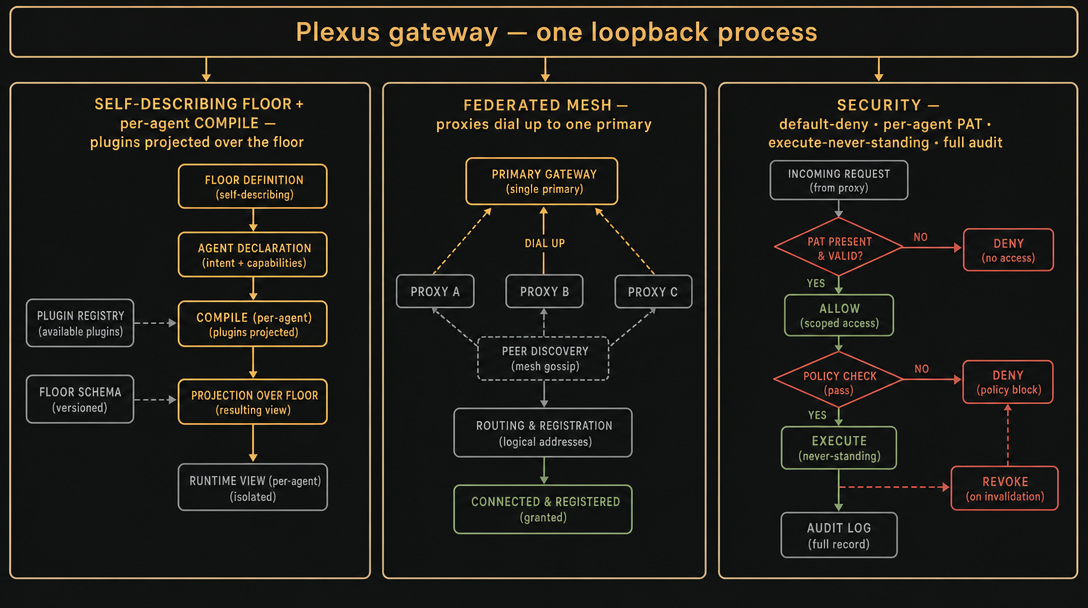
The compile model — the self-integrating resource
A cold agent, even facing a perfect self-describing surface, still has to learn a novel protocol on the fly. Plexus removes that step: it compiles the resource into the agent's own idiom and hands it over installed. An always-present Floor (.well-known/plexus + request shapes + per-capability schemas + how-to-use skills) is the source of truth for any agent; on top of it, Plexus deterministically renders a per-agent artifact (v1: a Claude Code plugin) that projects the selected capabilities into that agent's native form.
The projection is a cache, never a replacement — a stale skill can never exceed the Floor's live authorization, so the gateway stays the single enforcement point. Read the concepts / compile model for the mental model, and the DDD SSOT agent-skill-compile-domain-model.md for the full domain ledger.
The federated mesh — one front door, many homes
A capability need not live on the same machine as the gateway the agent talks to. A primary gateway (the agent's front door: it holds grants, runs the authorizer, sinks audit) can mount capabilities borne by any number of proxy gateways that live next to real services and dial a single persistent tunnel outward — no inbound hole on a proxy host. The agent invokes a mounted capability exactly as it would a local one; origin is a routing detail invisible to the authorization model.
→ The federated mesh — the developer-facing code map.
The security model — two trust boundaries
There are exactly two trust boundaries, held by two different parties. The connection-key is the owner's admin credential and agents never hold it. Each agent authenticates with its own durable per-agent PAT, redeemed once from a one-time enrollment code, so the blast radius of a leaked agent credential is one agent's pre-granted capabilities — independently revocable. Sensitive actions default to per-use approval: running code (execute) rides a standing grant only when the owner opts that specific agent + capability in at connect time (default off, double-confirmed) — never something the agent can lift itself.
→ The security model — the authoritative trust and authorization model, cited to code. Where the model is going — task tickets, enterprise attribution, pluggable policy — is locked as seams in authorization extensibility (ADR-020).
The protocol — the wire contract
The stable, AI-native contract everything else is typed against: DISCOVER → ENROLL → HANDSHAKE → GRANT → INVOKE, at contract version 0.1.3.
→ The protocol and its decision log.
Deeper design docs
These live in the repository — they are the design SSOTs behind the pages above:
architecture.md— the core map: the four planes, the runtime spine, the three extension axes, and the invariants ledger.authz-extensibility.md— the 1.0 authorization seams (ticket vs badge, ADR-020).federated-mesh-domain-model.md— the mesh DDD SSOT (language + invariants A–G).agent-skill-compile-domain-model.md— the compile-model SSOT.capability-appliance.md— the containerization appliance ("expose a capability, not a system").linux-confinement.md— the seatbelt → bwrap exec-confinement mapping.encryption-policy.md·networking-resilience.md·mesh-health-reporting.md— mesh transport, resilience, and health.