
Plexus concepts — the mental model
Plexus is a local capability gateway. It runs on your Mac, loopback by default; any wider exposure is opt-in and user-confirmed — a LAN bind via network.json, or publishing under a tunnel-fronted hostname via publicHostnames / PLEXUS_PUBLIC_HOSTNAME (the home-gateway example is the recipe) — with the connection-key as the trust boundary. It gives any AI agent a single AI-native protocol to discover → understand → be granted → call the capabilities of the software you already use: your notes, your calendar, your reminders, your tools. A federated multi-host topology is a documented design direction (draft) — see the federated mesh.
This is the keystone document. Read it once and the rest of Plexus (the getting-started guide, the security model, and the tutorials) will click into place.
1. Connector → Source → Capability
Everything in Plexus is organized along one spine. Each layer answers one question:
| Layer | The question | Example |
|---|---|---|
| Connector | How does Plexus connect to this kind of thing? | "Obsidian Local REST API", "Obsidian vault (filesystem)", "Claude Code" |
| Source | What did you actually connect? | your specific vault at ~/Documents/MyVault; your running REST plugin |
| Capability | What can an agent do with it? | obsidian.vault.read, apple-calendar.events.list |
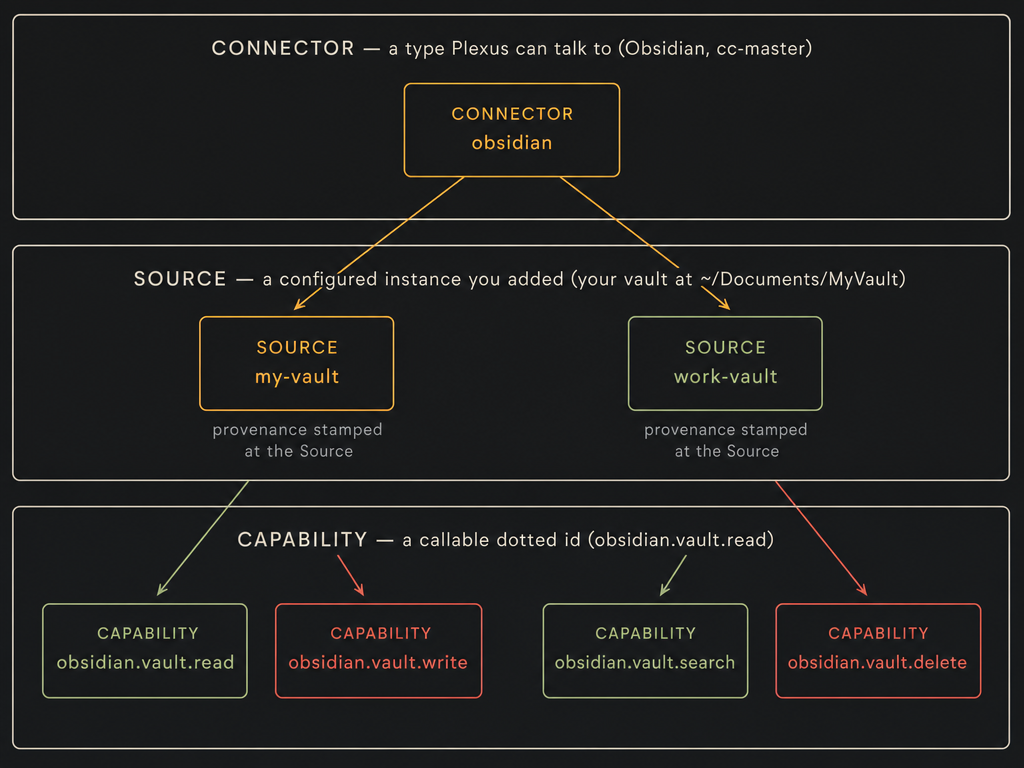
A Connector is a type Plexus knows how to talk to. It is pure catalog data — it declares the config fields that drive the "Add…" form, the resulting transport, and a one-liner of what it exposes. It carries no secrets and registers nothing on its own. Browse the catalog at
GET /admin/api/connectors.A Source is a configured instance of a connector — the real thing you added. Sources are managed: you add / remove / enable / disable / reconfigure them at runtime, they persist to
~/.plexus/sources.json, and they hot-reload into the live registry with no gateway restart. List them atGET /admin/api/sources.A Capability is one callable operation a source contributes — identified by a stable dotted id like
obsidian.vault.readorapple-calendar.events.list. Each capability declares its input/output schema, the verbs it requires (read/write/execute), a human-readabledescribe, and, optionally, attached skills: markdown guidance an agent can read to learn how to use it well.
The same Obsidian connector (the Local REST API kind) can back many sources (different vaults), each exposing the same capabilities (obsidian-rest.vault.{list,read,write}).
First-party capabilities ship in the box
Some sources are first-party — reserved, in-process, and present without any setup beyond the underlying app's own permission grant (the workspace and sandboxed-run sources need the owner to authorize a directory first):
| Source | Capabilities | Verbs |
|---|---|---|
apple-calendar | apple-calendar.calendars.list, apple-calendar.events.list | read |
apple-reminders | apple-reminders.lists.list, apple-reminders.reminders.list | read |
apple-reminders | apple-reminders.reminders.create, apple-reminders.reminders.complete | write |
workspace | workspace.list, workspace.read (workspace.how-to-use skill) | read |
workspace | workspace.write | write |
claudecode | claudecode.run (claudecode.how-to-use skill) | execute |
codex | codex.run (codex.how-to-use skill) | execute |
browser-control | browser-control.tabs.list, .page.read, .page.elements, .page.screenshot | read |
browser-control | browser-control.page.navigate, .page.click, .page.type, .page.evaluate | execute |
The Apple sources are read-only by construction for their list operations (the underlying provider has no write path at all for calendar/list reads). Reminders adds two write capabilities, which an agent can never self-grant — see the trust model below.
2. The trust model — default-deny, scoped, time-boxed
Plexus's central promise: an agent that can reach the gateway still has zero authority by default. Reaching the gateway, even handshaking successfully, buys an agent knowledge of the capabilities the owner authorized for it — never the right to call anything. Authority is granted by a human, scoped and time-boxed, and revocable at any moment.
A focused read
The material in this section has its own self-contained page: The trust model. This is the in-line summary.
Three clocks, not one
Plexus deliberately separates how long your approval stands, how long an agent's working episode lasts, and how long a single token lives:
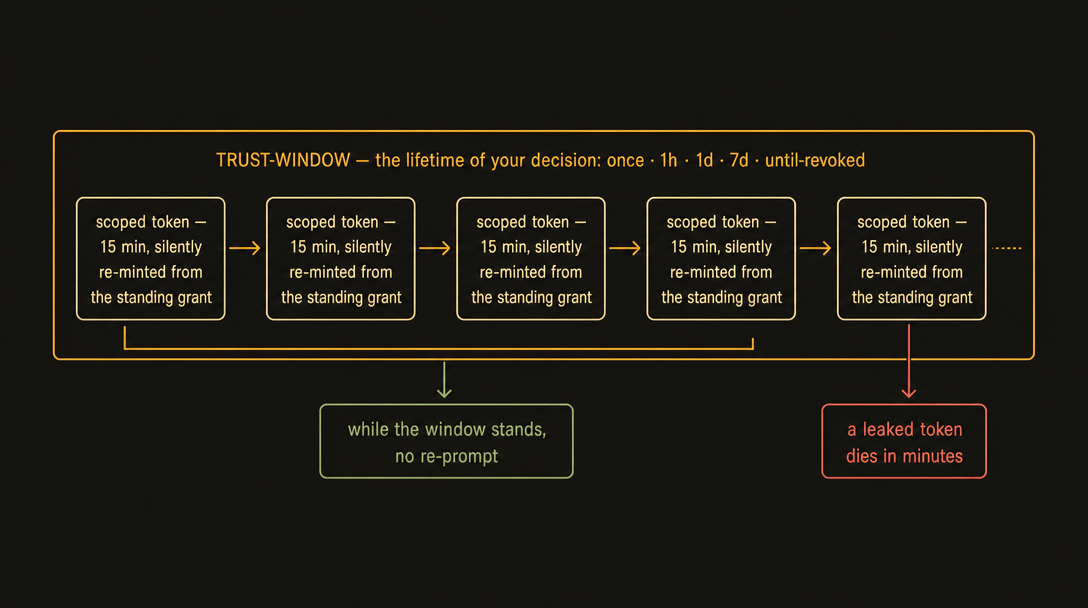
Trust-window — the lifetime of your decision. When you approve a grant you pick a window:
once,1h,1d,7d,until-revoked, or acustomduration. Until that window ends (or you revoke), the agent does not have to re-ask. This is the "standing grant."Session — the episode clock: how long authority flows silently. Every handshake opens a session (in-memory, 60 minutes, dead on gateway restart), and both
POST /invokeandPOST /grants/refreshrequire the presenting token's session to still be live. When the episode ends, the chain of silent re-mints ends with it — only the agent's PAT, in a fresh audited handshake, opens the next episode.Scoped token — the blast radius. Every actual call carries a short-lived bearer token, default 15 minutes (
DEFAULT_TOKEN_LIFETIME_MS, clamped to[1m, 60m]). When it expires the agent silently re-mints a fresh one from the standing grant viaPOST /grants/refresh— no connection-key, no re-prompt — as long as the trust-window still stands. A leaked token is therefore worthless within minutes.
The three form a containment ladder: PAT (identity, durable) → session (episode, ≤ 1 h) → token (blast radius, ~15 min). Each rung down is shorter-lived and narrower, and stealing a lower rung never climbs back up. See the trust model for the full argument.
A once grant is special: it stands for exactly one use (expiresAt = grantedAt), cannot be refreshed, and never short-circuits a future approval.
Standing-eligibility follows sensitivity, not origin (ADR-5)
Not every window is available for every capability. Whether a grant can be standing at all is decided by the capability's own sensitivity — derived from provenance × verb — never by where it came from:
- A
readcapability can be standing: once approved it takes a real window (first-party/managed default7d;writedefaults to1d), so subsequent in-scope reads are frictionless until the window ends or you revoke. - An
execute(or otherwise high-sensitivity) capability defaults to per-use approval, capped atonce— and the agent can never lift that itself, whatever window it requests. Running code (claudecode.run,codex.run) warrants a fresh human decision by default. The owner may opt a specific agent + capability pair into a standing execute grant at connect time (default off, double-confirmed); once opted in, that grant rides a real window oruntil-revokedlike any other standing grant.
So the trust-window picker offers a durable window for a read, while an execute grant is once by default — standing eligibility is a property of the capability plus a deliberate owner opt-in, never a choice the agent can make for itself.
Provenance — the three source classes (the organizing axis)
One fact governs how cautious Plexus is with a capability: its provenance — where the capability came from.
| Provenance | Means | Default posture |
|---|---|---|
| first-party | A reserved, in-process source (Apple Calendar/Reminders, Obsidian filesystem, Claude Code). | Read flows easily; write/execute still asks a human. |
| managed | A source you added through the trusted /admin UI (e.g. an Obsidian REST vault). Human-vetted at add-time. | Shares first-party read posture; write/exec still pends for a human. |
| extension | Wire-registered by an agent via POST /extensions. The strictest class. | Any verb pends for a human. |
Provenance is the organizing axis because trust should follow origin. A first-party calendar read and an agent-registered shell wrapper are not the same risk, and Plexus never pretends they are. The gateway stamps provenance from the source — an extension cannot impersonate a first-party id (those ids are reserved).
Sensitivity — the derived risk tier
From provenance + verb + transport, the gateway computes a sensitivity tier, purely for honest narration (so the UI and every agent describe the same risk):
- low — read on first-party / managed.
- elevated — write/exec on first-party / managed, or read on an extension.
- high — write/exec on an extension, or any
cli/local-resttransport with write/exec.
Workflows roll up their members' sensitivity (the max wins).
The grant ledger and revocation
Standing grants are first-class and visible from both sides:
- The user sees them in the
/adminGrants tab. - The agent sees its own standing grants at
GET /grants(session-authenticated).
Each row carries the agent, the capability, the verbs, the provenance, sensitivity, the trust-window, and the expiry. Revoke at any time:
- A human revokes from the Grants tab, or via
POST /grants/revokewith the management connection-key (byjti, by(agentId, capabilityId), or bybundleIdfor a whole task bundle). - An agent may relinquish its own token by presenting that token and its
jtito the same endpoint.
The exposure gate — the owner's outer toggle
Grants decide what an agent may call; exposure (what-I-expose) is the owner's outer gate sitting in front of them. A capability the owner disables is invisible in discovery, not grantable, and denied at invoke with capability_unexposed — enforced before the grant check. So effective access = granted ∧ exposed: revoking exposure cuts off a capability no matter what standing grants exist. (Shipped: packages/runtime/src/core/exposure.ts, with the denial wired in pipeline.ts.)
The two-mode authorization UX
Plexus supports two complementary ways for a human to approve work:
Ad-hoc (per-operation) approval. The agent requests a grant when it needs one; for a capability inside its authorized subset, a standing grant (e.g. a read you selected at connect) passes straight through, and anything else pends for you (
grant_pending_user) — a request outside the subset is denied outright, with no card to answer. When a request pends, you see a gateway-authored card — not agent prose — telling you exactly who wants to do what, for how long, with a "revoke anytime" reminder. You approve and pick a trust-window, or deny.Scoped task bundles (mechanism retained; not surfaced in the 1.0 console). Beyond ad-hoc approval, Plexus keeps a task-bundle mechanism: a named bundle of grants (plus their scope constraints and any attached in-scope context) pre-authorized to one agent up front. The bundle is purely a grouping of standing grants under a shared
bundleId— it confers no authority beyond its members, but it lets you reason about, and revoke, a whole task at once, and the agent can pull its attached context in one call viaGET /grants/context?bundle=<id>. The 1.0 admin console does not surface bundle authoring yet; the mechanism is retained as the proto-ticket for the authorization-extensibility roadmap (ADR-020). A bundle member simply appears as a normal standing grant in the meantime.
One honesty property runs through both modes: the narration the human reads is authored by the gateway, not the agent. The agent may attach a free-text "why now" purpose, but it is shown labeled "the agent says:", is sanitized and truncated, and influences no authorization decision. The agent can never spoof the risk summary.
For the full threat model and the trust boundary, read the security model.
3. MCP vs Plexus — "what functions" vs "how to use me"
Plexus is not a competitor to MCP; it answers a different question.
- MCP describes what functions a server exposes — a list of tools with schemas an agent can call. It is a tool-calling transport, and (since MCP
2026-07-28) a deliberately stateless one: identity, authorization, and cross-request state live outside the protocol. - Plexus describes how to use the user's machine — and gates it. Its discovery answers a different question than MCP's: not "what functions are here" but "how do I become authorized?" — one URL self-describes the whole lifecycle (enroll, handshake, grant, invoke), and the catalog itself is the product of authorization: an agent's discovered surface IS its authorized subset. On top of that: provenance / sensitivity so risk is legible; scoped, time-boxed, human-approved grants so authority is default-deny; attached skills so an agent learns how to use a capability well, not just its signature; and a standing-grant ledger so trust is auditable and revocable — exactly the identity/authorization/state layer the MCP wire leaves outside itself.
Status
The MCP transport/client layer exists and is tested, but the user-facing "wrap an MCP server as a source" path is not shipped yet (no MCP source module in the production registry) — today you expose capabilities via first-party sources or by authoring an extension. See KNOWN-LIMITATIONS. The design direction below describes where this is headed.
Concretely: MCP servers can be ingested into Plexus as a transport:"mcp" source, and their tools become Plexus capabilities (with lossless MCP provenance preserved so Plexus can round-trip back to the origin server). MCP is one of the transports Plexus speaks; Plexus is the trust + discovery + capability layer on top.
4. The self-describe protocol — two tiers
Plexus discovery is tiered: each tier reveals exactly as much as the moment warrants.
Tier 1 — the .well-known entry point (pre-session, unauthenticated)
GET /.well-known/plexusReturns the gateway identity, the auth advertisement (the URLs of every session endpoint — handshakeUrl, grantsUrl, invokeUrl, …), the enrollment self-description (auth.enrollment: how to redeem a one-time code for a PAT), and a capabilitiesVia pointer: enroll and handshake to receive the list of capabilities Plexus has authorized you to access. An agent reads endpoint URLs from this advertisement rather than hard-coding paths; its capability list arrives with the handshake manifest (Tier 2). No credential is needed and none is offered — the connection-key never appears here (it is admin-only). This public, self-describing surface is the Floor (see §5).
Tier 2 — the handshake manifest (post-session, full detail)
An agent opens a session with its own per-agent PAT — never the connection-key:
POST /link/handshake Authorization: Bearer plx_agent_…The gateway resolves the PAT to the agent's real agentId (a client can't self-assert another agent's identity) and returns a session plus the agent's manifest — its owner-authorized subset, every entry in it with its complete describe, input/output schemas, required verbs, transport, default trust-window, and attached skill bodies. After the handshake the agent knows its subset and can call nothing: default-deny until it requests a grant — and a grant request for a capability outside the subset is denied outright.
Where does the PAT come from? The agent redeems it once, before its first handshake, from a one-time enrollment code the admin minted when connecting it (see §5). The connection-key is the admin/management credential and gates the admin path of the handshake — it is not what an agent presents.
The full agent loop, end to end:
0. DISCOVER    GET  /.well-known/plexus           (gateway identity + endpoint URLs + enrollment self-description)
1. ENROLL      POST /agents/enroll                (one-time code → durable per-agent PAT, stored 0600)
2. HANDSHAKE   POST /link/handshake               (Bearer PAT → real agentId → session + subset manifest)
3. GRANT       PUT  /grants                        (request scoped access → token, or pend for a human)
4. INVOKE      POST /invoke                        (Bearer scoped token → result → audit event)
Step 0 is unauthenticated; step 1 runs once per agent; steps 2–4 repeat. A complete, dependency-light reference implementation of the agent side lives in examples/min-agent/client.ts; a runnable, self-contained end-to-end demo is bun run examples/min-agent/run.ts.
5. The compile model — the Floor and its projections
A focused read
This section has its own self-contained page: The compile model.
Everything above (.well-known + requestShapes + per-capability how-to-use + I/O schemas) is the Floor: the always-present, self-describing resource surface. The Floor works for any agent over plain HTTP, with no plugin installed — enroll, handshake, grant, invoke are all discoverable from it. Nothing an agent needs is hidden behind bespoke tooling.
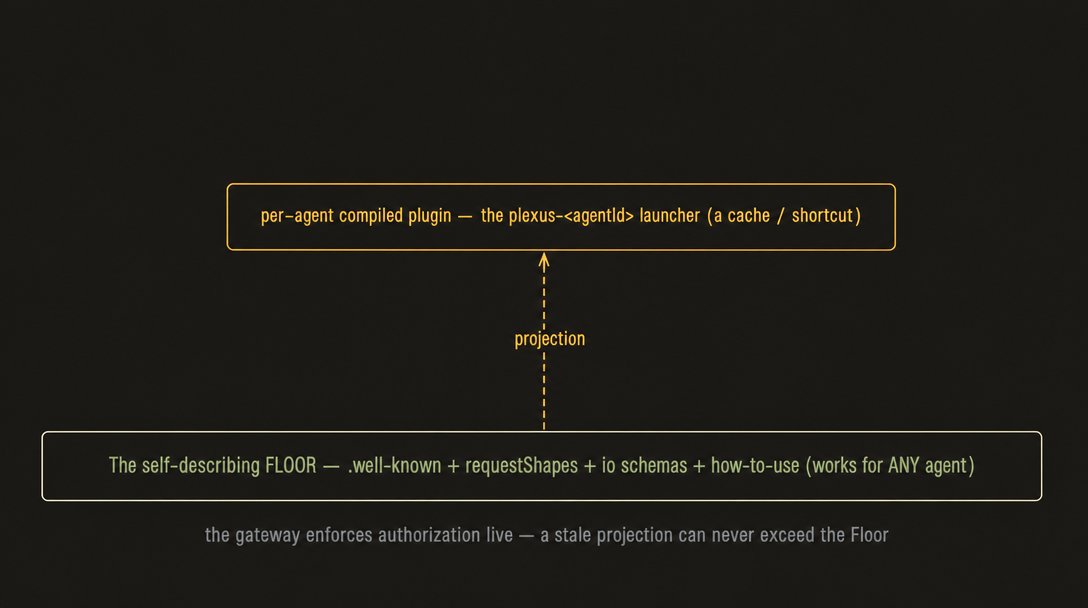
On top of the Floor, Plexus compiles a per-agent artifact (v1: a Claude Code plugin) that makes the same capabilities feel native to that specific agent. The artifact is a projection over the Floor — a cache/shortcut, never a replacement. It ships a version-isolated per-agent launcher plexus-<agentId> (its own bundled engine + a baked-in PLEXUS_AGENT_ID, so two agents on one host never collide and each pins its own engine version — never a bare/global plexus). Its subcommands:
plexus-<agentId> enroll <code>— redeem the one-time code → PAT → self-store (first run only).plexus-<agentId> list— the discovery verb: enumerate this agent's capabilities, split into callable-now (standing-granted) vs needs-approval. This is how an agent orients — including any capability the owner authorizes for this agent after the plugin was compiled (the Floor is live; the projection just caches it).plexus-<agentId> <capabilityId> [args]— invoke a capability.
The launcher is the agent's complete and only interface. The compiled skill states this as a hard rule: drive every interaction through plexus-<agentId> …; never hand-roll HTTP against the gateway, never guess an auth path. The auth/invoke core inside the launcher is deterministically templated from the Floor and verified against it — never LLM-authored, and no durable secret is ever baked into the distributed artifact (only the short-lived, single-use code rides the install). Because a skill is a projection and the gateway enforces authz live, a stale or mis-generated skill can never exceed the Floor's authority — worst case it references a revoked capability and the invoke fails at the gateway.
Where to go next
- Get running — install Plexus and connect your first agent end to end on macOS.
- The trust model — default-deny, the three clocks, provenance, sensitivity, and the execute-defaults-to-once rule (owner opt-in required to lift it).
- The compile model — the self-describing Floor and the per-agent compiled plugin as a projection over it.
- The security model — the canonical, code-cited credential model: connection-key (admin) vs per-agent PAT, and the
execute→oncedefault ceiling (lifted only by the owner's standing-execute opt-in). - Project README — the one-paragraph overview and repo map.