
Security & trust model
Audience
Someone deciding whether to trust Plexus with real resources, who needs to know exactly what each credential can do, what a leak of each costs, and how authorization flows. Every load-bearing claim cites file:line against the committed code so you can verify it yourself. The authoritative design ledger is agent-skill-compile-domain-model.md (Inv III = per-agent PAT / connection-key admin-only; Inv IV = through-primary equivalence; Inv VI = templated auth core). This document describes what the code enforces. Paths below are relative to packages/runtime/src/ unless noted.
The trust model in 5 sentences
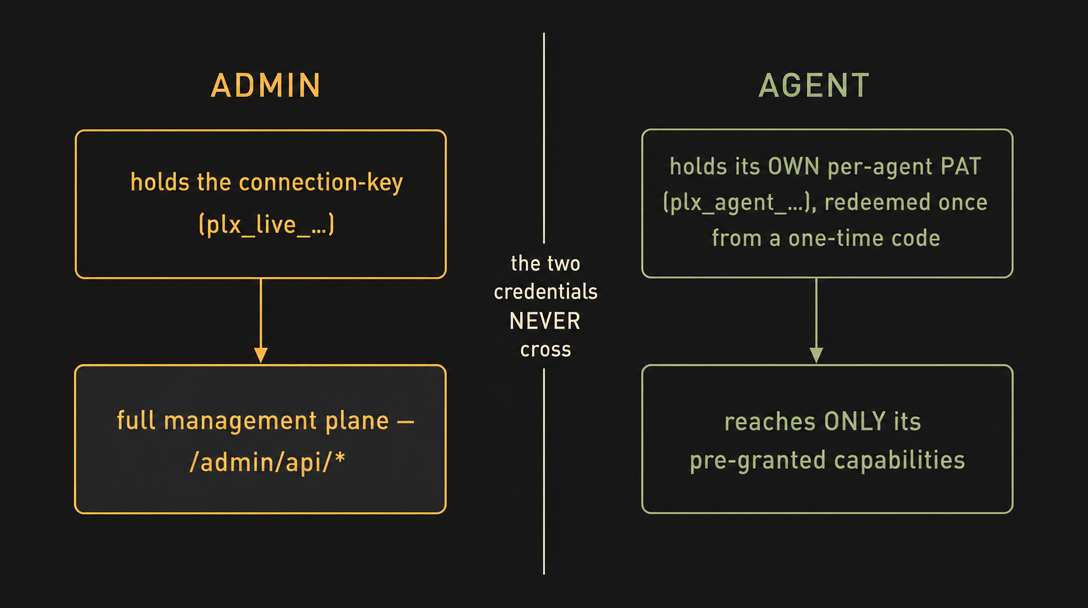
- There is exactly one admin trust boundary — the
connection-key(plus the wider management surface it authenticates) — and agents never hold it; an agent that only speaks HTTP can never reach the management plane. - Each agent authenticates with its own durable per-agent PAT, redeemed once from a one-time enrollment code, so the blast radius of a leaked agent credential is exactly that one agent's pre-granted capabilities, independently revocable.
- A grant is standing (frictionless re-use) only when the capability's own sensitivity permits it; running code (
execute) defaults to per-use approval (once) and rides a standing grant only when the owner opts that specific agent + capability in at connect time (default off, double-confirmed) — never something the agent can lift itself. - The PAT proves the real
agentId, so a client can never self-assert another agent's identity; the admin path may name anagentIdonly because holding the connection-key is the admin authority. - Every credential is hash-at-rest, fail-closed, and single-purpose, and the surfaces an agent can see (the "Floor") deliberately disclose only the sanctioned owner-approval path — never a hint that an on-disk key or a forgeable token exists.
1. Credential taxonomy & trust boundaries
Plexus has two trust boundaries and a small set of credentials on each side. The most important rule: the connection-key is admin-only; agents authenticate with a per-agent PAT.
| Credential | Who holds it | Authorizes | Lifetime | At rest | Blast radius if leaked |
|---|---|---|---|---|---|
| Admin connection-key | The local human / desktop app / plexus CLI — obtained out of band, never over HTTP | Full management plane: /admin/api/* (connect/revoke agents, grants, exposure, sources, mesh join tokens), and the admin path of handshake | Long-lived; rotatable (rotation invalidates sessions bootstrapped under the old key) | verified via state.connectionKey.verify(); never returned by any route | Total. Full admin authority over this gateway. This is the thing to protect. |
| Management key | Same as above | Same as above — "management key" and "connection-key" are the same secret presented as X-Plexus-Connection-Key on /admin/api/* and on privileged agent-plane actions (revoke-by-jti, grant-status-for-non-originator) | Same | Same | Same as connection-key. |
| Per-agent enrollment code | One specific agent, delivered out of band (rides the install command) | Redeeming once for that agent's PAT | 15 min, single-use (DEFAULT_CODE_TTL_MS) | sha256 hash only (codeHash) | One agent's bootstrap, and only within 15 min and only if unredeemed. After redemption it is inert. |
Per-agent PAT (plx_agent_…) | One specific agent, stored in its own paradigm (e.g. .env) | Opening a session as that agentId at handshake; from there, that agent's pre-granted (standing) capabilities | Durable until revoked / re-issued (no TTL) | sha256 hash only (patHash) | One agent's pre-granted capabilities, independently revocable. Cannot reach the management plane. |
Scoped token (signed JWT, tokenScheme: "plexus-scoped-jwt") | The agent that was granted | Invoking exactly the capabilities/verbs in its scopes, while its session is live and its jti un-revoked | Short: 15 min default, clamped to [1m, 60m] (config.ts:36-40) | Stateless signed JWT; jti tracked for revocation | A narrow, short-lived, revocable slice: specific caps for ≤60 min, killable by jti. |
| Mesh join token | A remote proxy operator, out of band | Enrolling one proxy workload into the mesh (pins its Ed25519 key) | Optional TTL, single-use | sha256 hash only | Admits one workload — and per §7, join grants zero capability visibility/access until the owner deliberately exposes + grants. |
Why the connection-key stays admin-only (verify this)
- No route returns it, and no payload hints it exists. There is deliberately no
GET /admin/api/connection-key(admin.ts:409-416). The rationale is written into the code: an untrusted agent speaks only HTTP, so any HTTP route that returned or hinted at the key would let the agent escalate to management. - The management plane is key-gated uniformly. One blanket middleware
admin.use("/api/*", requireManagementKey)(admin.ts:407) requires a verifiedX-Plexus-Connection-Keyon every/admin/api/*data route, reads and writes alike (requireManagementKey,admin.ts:383-399). The loopback Host/Origin guard alone is not treated as sufficient (any local process can sendHost: 127.0.0.1, and the gateway may be bound to a LAN interface). - Agents present a PAT, admins present the connection-key — different places. At
handshake, an agent presents aBearer plx_agent_…header; an admin presents{ "connectionKey": … }in the JSON body (handlers.ts:184-248). The two paths are selected by credential presence and never fall through to each other.
2. Authorization flow, end to end
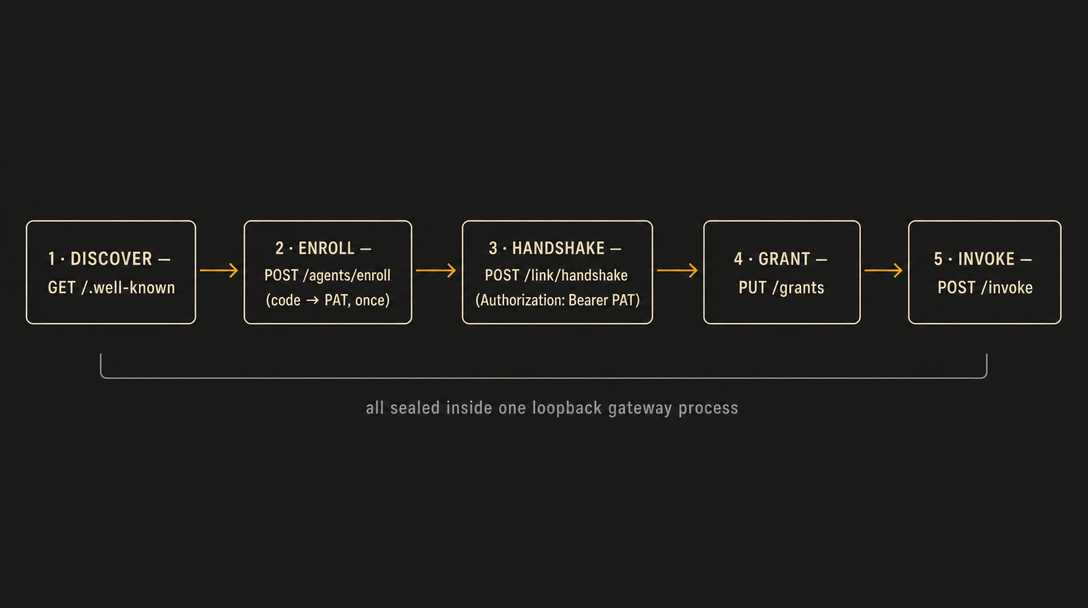
                         ┌─────────────────────────────────────────────────────────────┐
                         │  ADMIN (config-time, holds the connection-key, out-of-band)  │
                         │  POST /admin/api/agents/connect                              │
                         │   ├─ mint one-time enrollment code (plx_enroll_…, 15 min)    │
                         │   └─ declare selected cap-set as the authorized subset:      │
                         │      READ caps → STANDING grants (that IS the human approval)│
                         │      write/execute → per-use unless opted standing per cap   │
                         └───────────────┬──────────────────────────┬──────────────────┘
                                         │ install command          │ standing read grants
                                         │ carries the code          │ persisted for agentId
                                         ▼                          ▼
   AGENT                                                        GATEWAY (primary authority)
   ─────                                                        ─────────────────────────────
   (0) DISCOVER   GET /.well-known/plexus            ──►  unauth; returns gateway identity
                  (no credential)                          + auth advertisement + enrollment
                                                           self-description + capabilitiesVia
                                                           pointer               (well-known.ts)

   (1) ENROLL     POST /agents/enroll { code }       ──►  redeemEnrollmentCode(code):
                                                           shape→known→PENDING→fresh→mint PAT→
                                                           fsync→CONSUME code (single-use)
                  ◄── { pat: plx_agent_…, agentId }        (agent-enrollment.ts:391)
                  store PAT (own paradigm)                 PAT returned in plaintext ONCE

   (2) HANDSHAKE  POST /link/handshake               ──►  verifyPat(pat) → REAL agentId
                  Authorization: Bearer plx_agent_…        session bound to THAT id (not client-
                  ◄── { sessionId, manifest, … }           supplied)      (handlers.ts:195-231)

   (3) GRANT      PUT /grants { grants:{ id:"allow"}} ──►  per cap: in the agent's authorized
                  X-Plexus-Session: <sess>                 subset? ── no ─► DENIED (audited)
                                                           hasPriorApproval? (standing +
                                                           unexpired) ─ yes ─► short-circuit → token
                                                                              ─ no ──► authorizer:
                                                             low-risk 1P read → allow (auto)
                                                             write/exec / extension → PENDING
                  ◄── ScopedToken  OR  grant_pending_user   (grant-service.ts:542-733)

   (3b) APPROVE   (owner, in console)  POST /admin/api/pending/:id { action:"approve", trustWindow }
                                                       ──►  persist standing grant + mint token
                  agent polls GET /grants/status?pendingId=…  (originator- or mgmt-key-gated)
                  ◄── { state:"approved", token }        (handlers.ts:417-444)

   (4) INVOKE     POST /invoke { id, input }          ──►  verifyToken → jti/session liveness →
                  Authorization: Bearer <scoped-jwt>       exposure gate → constraint check →
                  ◄── { id, ok:true, output }              dispatch      (handlers.ts:561-626)
What is checked at each hop:
- (0) Discover — nothing.
.well-knownis public and unauthenticated by design; it advertises the gateway identity, the auth/lifecycle endpoint URLs, and the enrollment self-description, plus acapabilitiesViapointer: enroll and handshake to receive the capabilities the owner authorized for you. Capability discovery happens only after handshake, via the manifest scoped to the agent's authorized subset — which closes pre-identity enumeration. It never discloses the connection-key or any secret (buildPublicWellKnown,well-known.ts:168-177). - (1) Enroll — the code is the credential (
handlers.ts:279-324); the connection-key is never accepted here. Fail-closed: malformed body → 400; bad/used/expired code → 401 with a typed reason; durable-write failure → 500 with the code left unconsumed for retry. The redeem itself runs five checks in order and only mints on success (redeemEnrollmentCode,agent-enrollment.ts:391). - (2) Handshake — a
Bearertoken is treated as a PAT auth attempt and must verify; a forged/revoked/expired/non-PAT bearer fails closed (401, no session) and does not fall through to the connection-key. The session binds to the PAT's verifiedagentId; anyclient.agentIdis coerced to it (handlers.ts:197-215,sessions.ts:74-93). - (3) Grant — see §3. For a scoped agent, a request for a capability outside its owner-authorized subset is denied outright (audited), never pended — unless an owner-issued standing grant for it already exists; the authoritative admin path (the flow that defines the subset at connect) is exempt (
grant-service.ts:613-646). Within the subset, a standing+unexpired prior grant short-circuits the authorizer; otherwise theUserConfirmAuthorizerdecides auto-allow vs pend (authorizer.ts:218-280). Unknown capability ids are rejected 400 (no silent skip, no hollow token) before the grant service is touched (handlers.ts:380-387). - (4) Invoke — token signature, jti revocation, and session liveness are all enforced (and a denial is audited, not silently dropped) inside the pipeline (
handlers.ts:585-626). A top-level-disabled ("unexposed") capability is refused even with a valid token.
3. Standing grants, trust-windows & sensitivity
A standing grant is the durable record that lets an agent's later in-scope request short-circuit human approval. Standing-eligibility is decided by capability sensitivity, which is derived from provenance × verb — not by whether the capability is local or remote (ADR-5 / Inv IV).
Sensitivity → trust-window
recommendedTrustWindowFor(provenance, verbs, table) (capability-registry.ts:163-173) maps:
execute(any provenance/origin) →once. This is the one act whose sensitivity defaults to per-use approval. It keys on the verb, which survives a mesh mount, so a meshexecutecap and a localexecutecap both getonce— nothing getsoncemerely for being remote (capability-registry.ts:168-169).read/write→ the standing-eligible per-class default fromDEFAULT_TRUST_WINDOWS(config.ts:67-74):class read write first-party 7d 1d managed 7d 1d extension 1d 1d Note
extension:writeis1d(a real standing window), notonce. The older "mesh/extension caps hardcoded toonce" behavior conflated remote with per-use-only and was removed (config.ts:56-66).
The execute → once default ceiling (verify this)
chooseTrustWindow (grant-service.ts:461-506) is the single choke point that resolves the window actually applied. Two guards make the per-use posture structural:
// grant-service.ts (chooseTrustWindow)
if (this.isAnon(opts.agentId)) return { kind: "once" };     // ~476  anon:* capped
if (def.kind === "once") {                                  // ~484  execute: per-use DEFAULT
  if (!optedStanding) return { kind: "once" };              //       no owner opt-in → hard floor
  // opted in: honor the admin window; absent → until-revoked (or 7d when disallowed)
  …
}
The def.kind === "once" branch is the load-bearing rule: when the capability's own sensitivity yields a once default (exactly the execute case), once is returned regardless of what was requested and regardless of whether the pick is admin-authoritative — unless the owner has opted that specific (agent, capability) pair into a standing execute grant at connect time (ADR-023: default off, double-confirmed, independently revocable). The opt-in is consulted via agentSubsets.isStanding and persisted only by the owner's connect flow (the per-capability standing field of POST /admin/api/agents/connect in core/admin.ts; the legacy standingExecute key is accepted as an alias) — an agent can never set it itself. An opted-in execute grant honors the admin's authoritative window, or stands until-revoked absent one (clamped to 7d when until-revoked is disallowed by policy). For read/write the default is never once, so this clause never fires for them and a legitimate admin window survives. The clamp is applied on both the authoritative (admin) and advisory (agent) paths — every mint site funnels through chooseTrustWindow (grant-service.ts:666, 1119, 1476).
Other standing-grant rules
- First grant pends for extension; re-use short-circuits.
hasPriorApprovalreturns true only for a standing + unexpired grant (grant-service.ts:394-402,isStandingAndUnexpired); aonceor expired grant never short-circuits. So the first ask for a write/extension cap pends for the owner; subsequent in-scope asks are frictionless. anon:*→once. A session with no verified agentId (anon:<sessionId>) never gets a durable standing grant — capped atoncein bothchooseTrustWindow(grant-service.ts:~476) and the authorizer's window pick (authorizer.ts:213-215).- Agent windows are advisory, admin windows authoritative. An agent may propose a window on
PUT /grantsbut it may only shorten, never lengthen past the per-class ceiling (shorterWindow,grant-service.ts:88-90, applied at:505). The admin/human approve pick is authoritative (still subject to the un-optedexecute→onceanduntil-revoked-policy clamps). - Constraints only narrow. A constrained standing grant short-circuits a bare or deep-equal request but not a broader/different one, and the minted token always carries the standing grant's constraint, never a widened one (
effectiveConstraint,grant-service.ts:428-434).
4. Identity & anti-spoofing
The pre-feat/agent-skill-compile weakness was a self-asserted agentId: a client could claim to be any agent. The PAT closes this.
- The PAT binds the real agentId. At
handshake, aBearertoken is resolved through the enrollment ledger:verifyPat(pat)returns theagentIdof the active row whosepatHashmatches, ornull(verifyPat,agent-enrollment.ts:438). The session is then opened bound to that id, and the client-suppliedagentIdis overwritten with the verified one (handlers.ts:214-215). - The session store treats explicit agentId as trusted, client.agentId as untrusted.
open(bootstrapKey, client, agentId)uses the explicit verifiedagentIdwhen present and overrides anyclient.agentId; the free-formclient.agentIdis audit metadata only and is never, on its own, a trustworthy identity for a public caller (sessions.ts:33-46, 74-93). - A stolen agentId string buys nothing. Replay/forge resistance comes from the PAT verifier (hash-at-rest, per-agent, revocable) — naming an agent without its PAT gets you a 401, no session (
handlers.ts:197-209). - Why the admin path may still name an agentId. The connection-key body path may legitimately name the
agentIdit acts on behalf of (the console's "connect an agent" does exactly this). That is not a spoof: possessing the connection-key is the admin authority, and an agent has no connection-key to reach that path with (handlers.ts:174-182,admin.ts:668).
5. Revocation & blast radius
"Revoke an agent" means all of that agent's access dies immediately, and nothing else is touched. The admin route POST /admin/api/agents/revoke (admin.ts:838) does three per-agent-scoped things:
- Enrollment / PAT —
agentEnrollment.revoke(agentId)flips the row torevokedand drops itspatHashfrom the active index, so the PAT stops verifying immediately; future handshakes with it fail closed (agent-enrollment.ts:457). - Live sessions —
sessions.invalidateByAgentId(agentId)invalidates every live session bound to that agentId and returns their jtis, which are then revoked. This makes revoke immediate rather than delayed by ~session-lifetime, and reaches sessions by identity (the admin knows the agentId, not the raw PAT) (sessions.ts:126-139,admin.ts:871-877). - Standing grants + live tokens —
grants.revokeAllForAgent(agentId)removes the agent's durable grants (so refresh can't re-mint) and tombstones each pair (so a still-running agent's bare re-request re-confirms with a human instead of silently re-auto-allowing a low-risk read), then revokes any remaining tracked jtis (revokeAllForAgent,grant-service.ts:1396).
Per-agent isolation. Every step keys on agentId; a second agent's enrollment, sessions, and grants are untouched. This is the concrete payoff of the per-agent PAT: revocation is scoped to one agent, unlike a shared credential whose rotation would cut everyone off.
Revocation tombstone. After a revoke, a just-revoked (agentId, cap) low-risk read that would normally auto-allow instead pends for a human (authorizer.ts:266-271, ctx.revokedTombstone); a fresh human approval lifts the tombstone. "Revoke is the complete stop."
Related revocation paths: connection-key rotation invalidates sessions bootstrapped under the old key (sessions.invalidateByKey, sessions.ts:115-124) — note that PAT-bootstrapped agent sessions are bootstrapped under the PAT, not the connection-key, so they are deliberately decoupled from key rotation and die only with their own PAT. An agent may relinquish its own token by presenting it (revoke path b, handlers.ts:512-533); revoke-by-jti-for-someone-else and revoke-by-bundle require the management key (handlers.ts:536-539).
Revocation deletes the grant row — the audit log keeps the story. Removing the durable record is what makes revoke final (refresh can't re-mint), so the replayable record of what was authorized is the audit trail, not the grant store. Every grant-lifecycle audit event carries the member's bundleId (stamped before row removal), so a task bundle's full story — pend → allow → re-mint → revoke — survives the rows within audit retention. This guarantee, and the other seams the authorization model keeps open for task-scoped and enterprise use, are locked in authorization extensibility (ADR-020).
Blast radius is sometimes a setup choice, not a runtime one
browser-control is the clearest case. Its three modes expose the same capabilities, and the owner's decision — a browser Plexus launched on an empty profile, or the browser they are logged into — is what sets the radius before any grant is asked for. Chrome's own consent cannot narrow it: the permission dialog authorizes the browser, not a set of sites. So the per-domain boundary is enforced here, on the real target URL, re-checked before every act, fail-closed when the owner has named no domain. See expose a source.
6. Compile-model security (self-integrating skills)
The compile model ships a resource to an agent as a native artifact (v1: a Claude Code plugin). Inv VI is the security spine: the auth/invoke core of any generated artifact is deterministically templated and Floor-verifiable, never LLM-authored, and no long-lived secret is baked into a distributed artifact.
- No secret is baked in; the one-time code rides the install. The distributed artifact contains no durable PAT and no admin key. The enrollment code (short-lived, single-use) may ride the install command, and is redeemed to a PAT the agent stores itself — the PAT is returned exactly once at redeem and never persisted into a shipped file (
well-known.ts:119-129describes the redeem→store contract;agent-enrollment.ts:122-128). - The hardened
.well-knownis the oracle. A build-time verifier (integration/verify-plugin.ts) checks a rendered plugin against the Floor across five independent axes, returning a structured pass/fail:- Sanctioned auth core —
bin/plexusis byte-identical (sha-256) to the committed sanctioned engine (tools/plexus-cli/plexus); the plumbing was not hand/LLM-altered. - No baked secret — no distributed file contains a
plx_agent_…PAT, a bakedplx_enroll_…code, or any caller-supplied durable credential (incl. the admin connection-key, passable asforbiddenSecrets). - Only advertised/granted caps — every capability the skill references is present in the Floor's advertised catalog (and, when supplied, within the cap-set the plugin was compiled for). A skill can never reference a cap the Floor does not advertise.
- Sanctioned flow — the enroll/handshake/invoke the plugin instructs matches the Floor's
auth.enrollment/requestShapes; no instruction file improvises an auth path (reads an on-disk admin key, or forges a token). - Prose integrity — the hand-authored skill body is hash-pinned (
SKILL_BODY_SHA256_PIN): the source prose must hash to the pinned oracle and the renderedSKILL.mdcarries it verbatim, so any edit to the pedagogical shell forces a deliberate re-review + re-pin before it can ship.
- Sanctioned auth core —
- Staleness is safe (Inv V). A skill is a projection over the Floor; the gateway enforces authz live. A stale or mis-generated skill can never exceed the Floor's authz — worst case is cosmetic (references a revoked cap → the invoke just fails at the gateway). Auto-update is a freshness/UX feature, not a safety feature; v1-partial: auto-update is deferred to v2.
7. Mesh trust
Mesh access is governed by through-the-primary equivalence (Inv IV / ADR-5): a capability routed from a mesh node is authorized identically to a local one — same PAT, same authorizer, same trust-windows. Origin is a routing detail invisible to the agent's authz path.
Two mesh-specific defenses back that up:
- Remote-asserted trust posture is never trusted. When a remote workload's caps are mounted, the primary strips any
provenance/sensitivity/recommendedTrustWindow/healththe proxy asserted and re-derives them locally. A mounted cap re-derives toextensionprovenance (the strictest class), so a mounted remote read pends and never auto-allows; a malicious proxy assertingprovenance:"first-party"cannot spoof the authorizer (capability-registry.ts:956-973). - Tunnel auth is mutual, pinned Ed25519, fail-closed. The proxy↔primary boundary is separate from the agent↔primary boundary. At join, a one-time join token (the nonce, sha256-at-rest, single-use) admits one workload and pins its Ed25519 public key (
mesh/enrollment.tsheader +admit). Every subsequent socket runs a mutual challenge — the primary verifies the proxy against the pinned key, the proxy verifies the primary against its pinnedupstream.primaryPubKey(mandatory: no bare TOFU) — and an unenrolled/unauthenticated socket is dropped before any data frame (mesh/handshake.ts:399-454). - Transport-encryption policy.
requireEncryption(PLEXUS_MESH_REQUIRE_ENCRYPTION) makes the primary refuse a plain-wsproxy tunnel with a typedencryption_requiredreason and accept onlywss(mesh/handshake.ts:399-403). Identity ⟂ encryption: this gates the channel, not the Ed25519 identity — a valid pinned key over plain ws is still refused. It fails fast at boot if enabled without TLS material (config.ts:645-650).
See the federated mesh for the full mesh developer model.
8. Error hygiene as a security property
A blind-test finding showed that vague auth errors tempt a careful agent to "go find a signing key on disk and mint its own token." The committed error surface treats legibility toward the sanctioned path as a security control:
- An
/invokewith a live session but no grant returns a structuredapproval_requiredwithpendingId+approvalUrl+grantStatusUrland the explicit message "Owner must approve this grant in the Plexus console; the agent cannot mint its own token" (handlers.ts:692-712). - An
/invokewith no session returns honestgrant_requiredguidance that points at handshake →PUT /grantsand states plainly that low-risk first-party reads are auto-granted and "the agent cannot mint its own token" (handlers.ts:634-652). .well-knownadvertises the grant-request entry point (grantRequestUrl+ method) and the enrollment redeem step, so the only advertised forward path is the audited, owner-approved one (well-known.ts:60-129). No response, error, or how-to hints that an on-disk key or a forgeable token exists.- The originator/management gate on
GET /grants/statusensures a minted token is only ever handed to the session that created the pending (or the management key) — a leakedpendingIdalone gets a 403, never the token (handlers.ts:417-444).
The principle: make the sanctioned path the only discoverable one, and never phrase an error in a way that steers a caller toward forging a credential or reading a key file.
9. Threat model — in-scope, out-of-scope, and the red-team result
In scope (the code defends these)
- A network/HTTP-only adversary (an agent, a LAN peer once LAN binding is enabled) trying to reach the management plane: blocked by the connection-key gate on all
/admin/api/*and the no-key-over-HTTP rule (admin.ts:383-416). - An agent trying to self-assert another agent's identity: blocked by PAT→agentId binding (§4).
- An agent trying to self-grant write/execute or grant against an extension cap without a human: blocked by the default
UserConfirmAuthorizer(authorizer.ts:180-280). - An agent trying to make running code (
execute) frictionless/standing on its own: structurally impossible — only the owner can opt a specific (agent, capability) pair into standing execute at connect (chooseTrustWindow,grant-service.ts:461-506). - A leaked agent credential: bounded to one agent's pre-granted caps, revocable in isolation (§5).
- A malicious mesh proxy asserting a favorable trust posture, or a plaintext/MITM tunnel: blocked by local re-derivation, pinned mutual auth, and the encryption policy (§7).
- Secrets at rest: enrollment codes, PATs, and mesh join tokens are sha256-hashed on disk (0600 ledger files); PAT/code plaintext is returned exactly once and never recoverable (
agent-enrollment.ts:36-39, 225-236).
Out of scope (documented assumptions — rely on OS/deployment, not Plexus code)
Same-UID host isolation
The per-agent-PAT isolation assumes the agent process cannot read the admin connection-key file. On a same-UID host an agent can cat ~/.plexus/connection-key and gain full admin authority — Plexus's in-process boundary cannot prevent a process that can read the owner's home directory. The mitigation is OS sandboxing / the container appliance (the mesh/appliance epic; see capability-appliance.md, linux-confinement.md), which puts the agent in a confinement that cannot read the key file. Until then, treat "the agent runs as the same user that owns ~/.plexus" as full admin trust in that agent.
- Host compromise / root, memory scraping of the live process, and side channels are out of scope for the application layer.
- v1-partial hardening, explicitly deferred:
- Keypair PATs. v1 uses a bearer PAT (chosen for the operator's
.envmental model + simplicity, ADR-4). A keypair PAT (proof-of-possession, so a leaked-at-rest credential is useless without the private key) is a documented v2 hardening over bearer PATs. - Skill auto-update (Inv V) — deferred; safety does not require it (§6).
- LLM-authored pedagogical shell — even in v2, the LLM may write only task-framing/examples, never the auth/invoke mechanics (Inv VI).
- Keypair PATs. v1 uses a bearer PAT (chosen for the operator's
Red-team result
Two adversarial red-team reviews were run on the committed auth spine + the admin/revoke path. Conclusion: the spine is clean. The one confirmed HIGH — an execute capability being allowed to ride a standing grant under an admin-supplied window with no owner decision anywhere — has been fixed; the fix is the def.kind === "once" clamp in chooseTrustWindow (grant-service.ts:484), applied on both the authoritative and advisory paths. ADR-023 keeps that clamp as the default and adds the one sanctioned lift: the owner's explicit per-(agent, capability) standing-execute opt-in, double-confirmed at connect.
10. What a developer must NOT do
- Do not bake the connection-key (or any durable secret) into anything agent-facing — not a skill, not a plugin, not a config the agent can read, not an HTTP response. The connection-key is admin-only; there is deliberately no route that returns it.
- Do not let a skill's auth/invoke core be LLM-authored or hand-edited. It must be the byte-identical sanctioned engine, verified against the Floor oracle (Inv VI,
verify-plugin.ts). An LLM writing the auth path could ship an over-reach tutorial. - Do not distribute a durable PAT. Ship the one-time code (short-lived, single-use); let the agent redeem and store its own PAT.
- Do not treat the loopback Host/Origin guard as authentication for management actions — it proves "an accepted authority," not "the trusted management client." Gate management routes on the verified connection-key.
- Do not add a management action that an agent can reach over the agent plane. Agent-plane actions must go through the authorizer (pend-for-owner) and never grant management authority.
- Do not let an
executecapability stand without the explicit per-(agent, capability) owner opt-in (default off, double-confirmed at connect). Keep the un-optedoncefloor inchooseTrustWindowintact, and keep the agent path advisory (shorten-only). - Do not trust remote-asserted trust posture (provenance/sensitivity/health) from a mesh proxy — always re-derive locally.
- Do not phrase an auth error in a way that implies a forgeable token or an on-disk key. Point callers at the sanctioned owner-approval path.
Appendix — key files
| Concern | File |
|---|---|
| Enrollment ledger (code→PAT, hash-at-rest, single-use, revoke) | core/agent-enrollment.ts |
| Two-credential handshake (PAT=agent, connection-key=admin) | core/handlers.ts (handshake, enrollAgent) |
Session binding, invalidateByAgentId/invalidateByKey | core/sessions.ts |
Grants, standing, hasPriorApproval, chooseTrustWindow, revokeAllForAgent | core/grant-service.ts |
Sensitivity→window, recommendedTrustWindowFor, mesh mount re-derivation | core/capability-registry.ts |
DEFAULT_TRUST_WINDOWS, clamps, requireEncryption fail-fast | config.ts |
| Management-key gate, connect/revoke an agent | core/admin.ts |
| Public Floor + enrollment self-description | core/well-known.ts |
| Pend / auto-approve / tombstone policy | auth/authorizer.ts |
| Build-time skill↔Floor verifier (Inv VI) | integration/verify-plugin.ts |
| Mesh join enrollment (Ed25519 pin), mutual tunnel auth + encryption policy | mesh/enrollment.ts, mesh/handshake.ts |